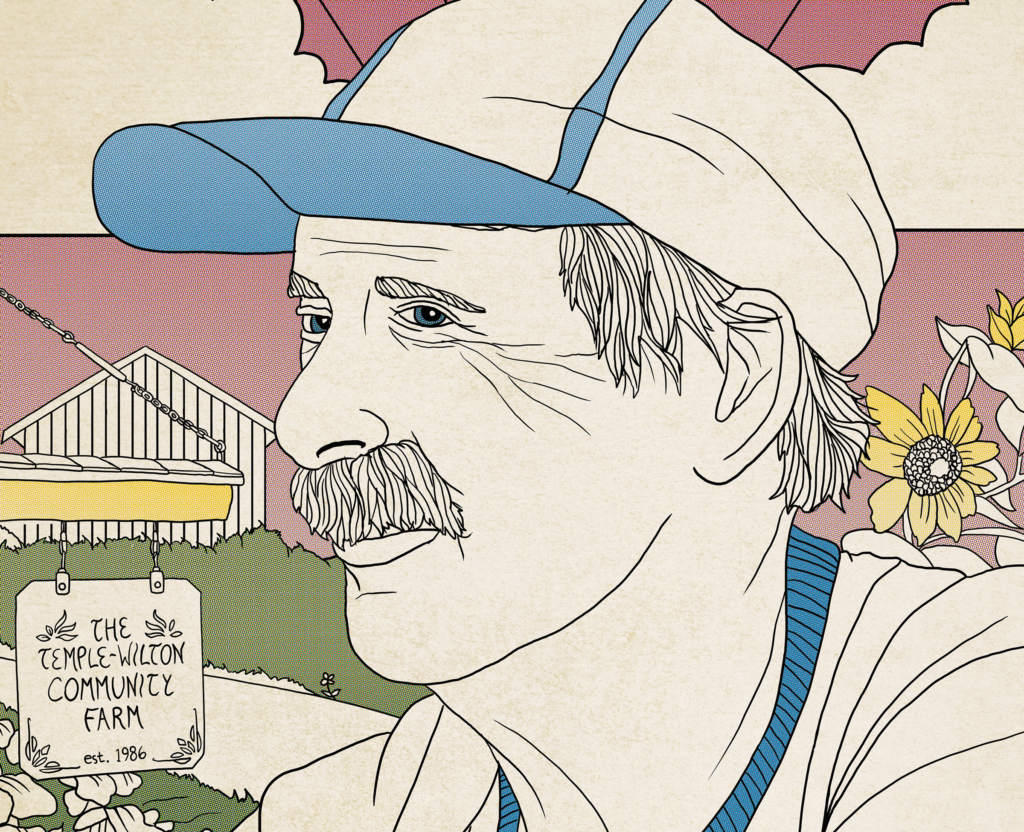
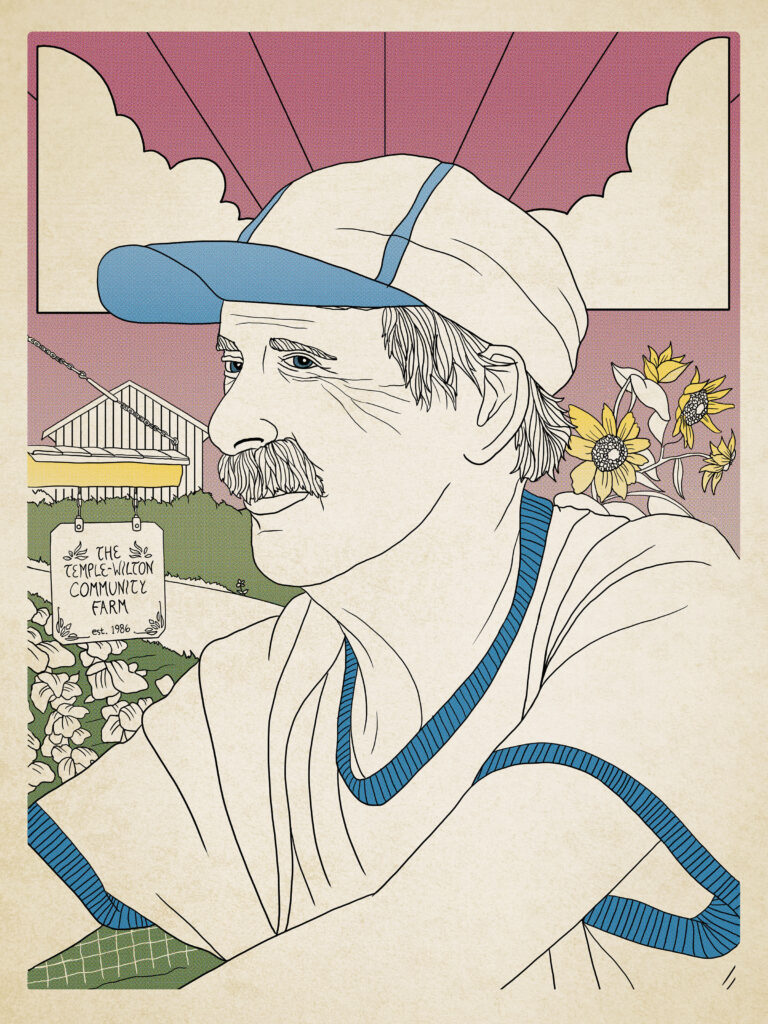
Lincoln Geiger never intended to help launch the community-supported agriculture (CSA) movement in the United States. In fact, the 76-year-old, who founded Temple-Wilton Community Farm in Wilton, New Hampshire, the country’s oldest continuously operating CSA program, spent most of his formative years in a small village in southern Sweden.
His parents, a filmmaker and a clothing designer, moved the family to Sweden from New York in the early 1960s. The slow, natural way of life in his new home entranced Geiger.
“We had a village sauna because most people didn’t have running water. On the weekend, it was open to the public for the families to come in. The farmers would come in, and we’d hear all the different, interesting latest news about what’s happening in town,” he tells The Rooted Journal. “So I got schooled in the kind of community of a village. Most of us don’t have that possibility anymore.”
Because he had lived in two countries, Geiger felt he had a different understanding of the world than the other children in the village. He describes those kids as being “completely immersed in the old side of life. I kind of grew up in a mix of feeling the wonders of modern things and the horror of modern things.”
Most of his classmates wanted to “get away from the farm,” he says. But Geiger didn’t. In his late teens, he became interested in biodynamic farming, an approach developed by scientist and philosopher Rudolf Steiner. Steiner believed that farming should work in harmony with the land and developed farming methods built upon holistic, spiritual processes. Growing plants, says Geiger, “is totally tied up with the cosmic world just as much as with the earthly world.”
He and his brother established a biodynamic farm in southern Sweden in the mid-’70s, which grew into a commune called Mother Earth. They restored an old water mill and built a community around sustainable, self-sufficient living. The commune became well-known for its biodynamic practices and products.
Geiger’s parents moved back to the States in 1978, and not long after, Geiger followed. His parents helped him buy 12 acres of land in Temple, New Hampshire.
“I had to weigh the benefits and the difficulties of the place,” he says. “New Hampshire is not exactly friendly farming-wise, as far as soil. It’s hilly, rocky … But that was kind of how I had grown up, because where we settled in Sweden happened to be on a glacial moraine full of rocks.”
Geiger was driven to start a CSA because he believes that “all people are, by nature, farmers, but not all have to farm. Some of us can take on active farming, and the rest of us will share the cost of the farm, support the economic and cultural life of the farm, and share the food.”
From ‘Clientele Membership Club’ to CSA
The idea of community-supported agriculture seems as old as time, but in the United States, the CSA movement is fairly new. In the 1970s, Booker T. Whatley, a Black horticulturist and professor at the Tuskegee University in Alabama, created what he called a “clientele membership club,” where members paid Whatley an annual fee to purchase crops below retail price. He explained to Mother Earth News in 1982 that the club model “enables the farmer to plan production, anticipate demand, and, of course, have a guaranteed market.” Whatley’s 1987 book, “How to Make $100,000 Farming 25 Acres,” is considered a foundational text of the movement.
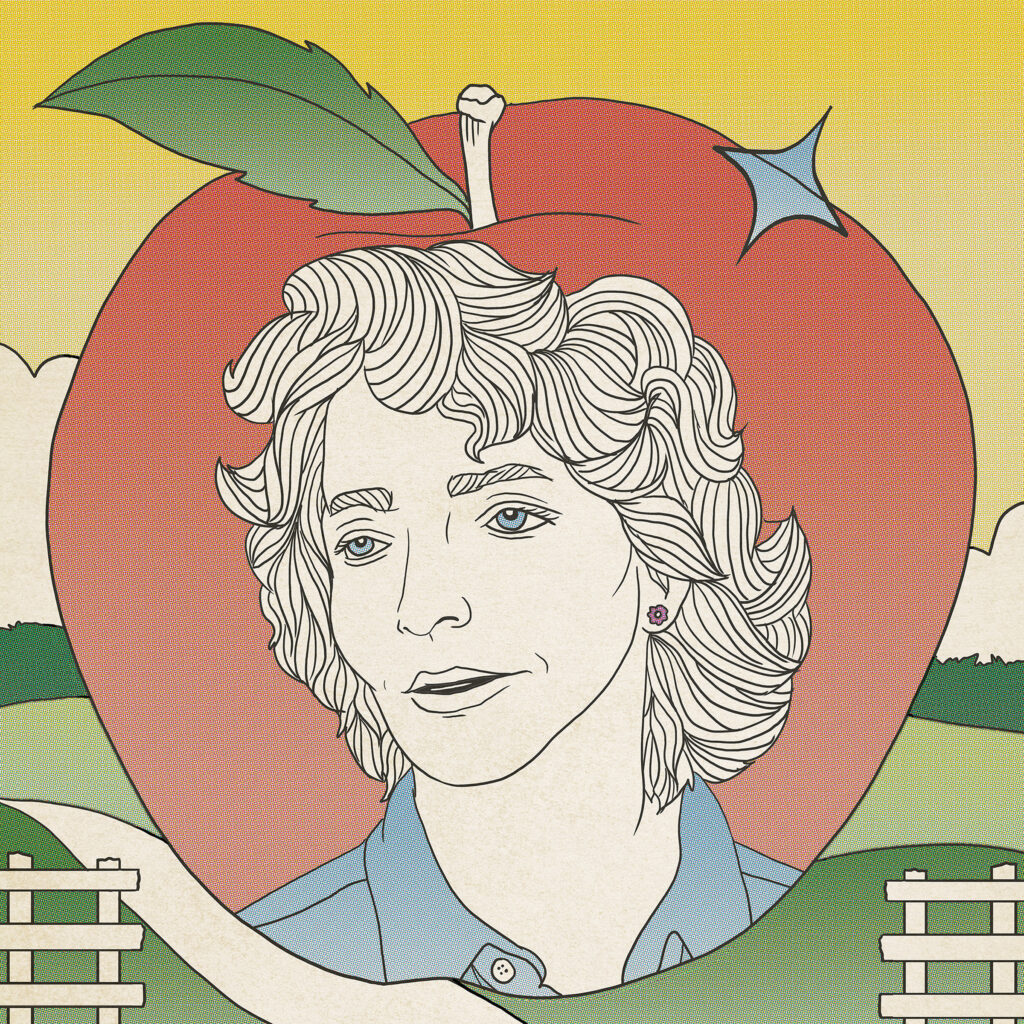
CSAs were further popularized in the 1980s by Robyn Van En, considered one of the founders of the U.S. CSA program. Van En launched a CSA program at her Indian Line Farm in South Egremont, Massachusetts, in 1985. The first year, “We offered shares of some of the local apple harvest, and members received storage apples and jugs of cider each week,” Van En wrote in 1992. “Most of the families from the apple project bought shares in the vegetable harvest for the following season.”
Van En went on to help start more than 200 CSAs around the country. “Because of their guaranteed incomes, CSA farmers are immune to the ‘bigger is better,’ ‘mine is better’ syndrome and are instead focused on finding new ways to cooperate with their neighbors and with Mother Nature,” she wrote for the sustainability-focused nonprofit Context Institute’s magazine, In Context, in 1995.
Food Is a ‘Gift, and We Don’t Want to Commodify the Gift’
While Van En was working in Massachusetts, Geiger was in the next state over, launching the organic and biodynamic Temple-Wilton Community Farm.
“There was a strong sense that food is not a commodity; it is a right,” says Geiger of the farm’s foundational philosophy. “All creatures on Earth have a right to share the food. And so when something grows, it’s primarily formed by outer forces and the Earth, not by the individual who happens to open up the soil and put some compost on. The rest of it is shaped by natural forces.”
“It’s a gift, and we don’t want to commodify the gift,” he continues. “So the idea was, we would have a farm that would grow food, people would share the cost of growing the food, and then share the outcome — the harvest, so to speak. And that became the basis of our CSA model.”
Initially, there were about 35 members. At a meeting each spring, members went around in a circle and declared how much they were willing to donate to the farm. Over time, as the farm grew to include more than 100 households, Geiger made the process more private. But little else on the farm has changed.
“When I go out to grow the food, when I go out to plant, I don’t think, ‘How many carrots and beets do I need to plant to make a living?’” says Geiger. “I have to think, ‘How many carrots and beets do I have to plant to feed this community?’ It’s a totally different perspective, and so when we’re planting, we’re thinking of people instead of money.”
He continues: “I’m growing things to feed a whole community, and the community helps to give me money so that I can do this job, so it makes a safe environment for the farmer.”
Geiger says conventional farming puts most small farmers in a financially precarious position, a reality you can see in the number of small farms that have disappeared over the past hundred years. Between 2017 and 2022 alone, the United States lost more than 100,000 farms, most of which made less than $50,000 a year. At the same time, the number of large-scale farms grew by more than 16%.
As he nears 80, Geiger is thinking about his legacy and what the farm will look like after he’s gone. The farm still struggles to find reliable vegetable farmers. It has moved from private ownership to a community-owned approach, and the owners are considering adding a board of directors. They’ve focused their efforts on buying and conserving land and now have 140 acres. And they’re looking to the next generation to keep the farm up and running. Eight years ago, Temple-Wilton established a school called Wild Rose Farm that teaches children agricultural practices.
Geiger hopes that as more people question the presence of chemicals and genetically modified organisms, or GMOs, in their food sources, they’ll start to see the interconnectedness between themselves and the food they eat.
“Each time there’s a new development, like when the GMOs came into being, we noticed an increase in folks who wanted to become farm members,” he says. “So as a response to all the things that come from the big agricultural and the economic world, we will continue to see people who respond that we can create a better world. We can maintain a better relationship with nature. Over time, I have no idea what [the farm] is going to look like, but it’s going to be there, and it’s going to be responsive.”