On a particularly soggy Hawaiian morning in West Maui, just off the Honoapi‘ilani Highway in Olowalu, a few miles south of Lahaina, Eddy Garcia greets me with a smile. He’s barefoot and shin-deep in a flooded parking lot, the giant puddles brought in by summer showers overnight.
I’ve come to meet Garcia and have a look at his operation — which, at the moment, feels a little underwater, although he seems unfazed. A regenerative farmer with the suntanned, board-shorted look of a guy who’s just gone surfing, Garcia is the executive director of the nonprofit Regenerative Education Centers. (He’s also the founder of Living Earth Systems, an agricultural cooperative that designs and builds regenerative farms and offers online courses.) Garcia is renowned on the island for being instrumental in providing organic produce and housing solutions to families affected by the 2023 Lahaina wildfire, the deadliest in modern U.S. history that took the lives of more than 100 people and burned down 2,200 homes, buildings, and other structures.
I tentatively follow the man through a swamped maze of Matson containers, hoping there are no live electrical wires anywhere, while Garcia, bubbly and talkative, couldn’t be more confident. Largely self-taught, Garcia has lived off-grid on the islands most of his life, growing or catching almost all the food he consumes. It was a choice he made not long after reading Masanobu Fukuoka’s seminal “The One-Straw Revolution: An Introduction to Natural Farming” as a young man.
“Basically, we teach people about regenerative agriculture, stewardship, and homesteading,” he explains, leading me to an opening behind the large containers where tanks of aquaponic-grown plants are being cultivated, among other setups that look like the work of a mad scientist. “It’s going to be a couple years before permanent housing is built, so we’re providing creative ways for folks who lost their homes to live. And not even just housing but off-grid, self-sufficient homesteads.”
“Homesteads?” I ask.
“Yeah, that means we’re also teaching them how to grow food around those areas and help them utilize the land that they’re on, so that they can continue to live sustainably for years to come. With regenerative agriculture, we’re approaching this all from a place of, How are we gonna repair or regenerate? The main point is giving people the tools to restore a balance so that this land serves the environment, community, and everything around them.”
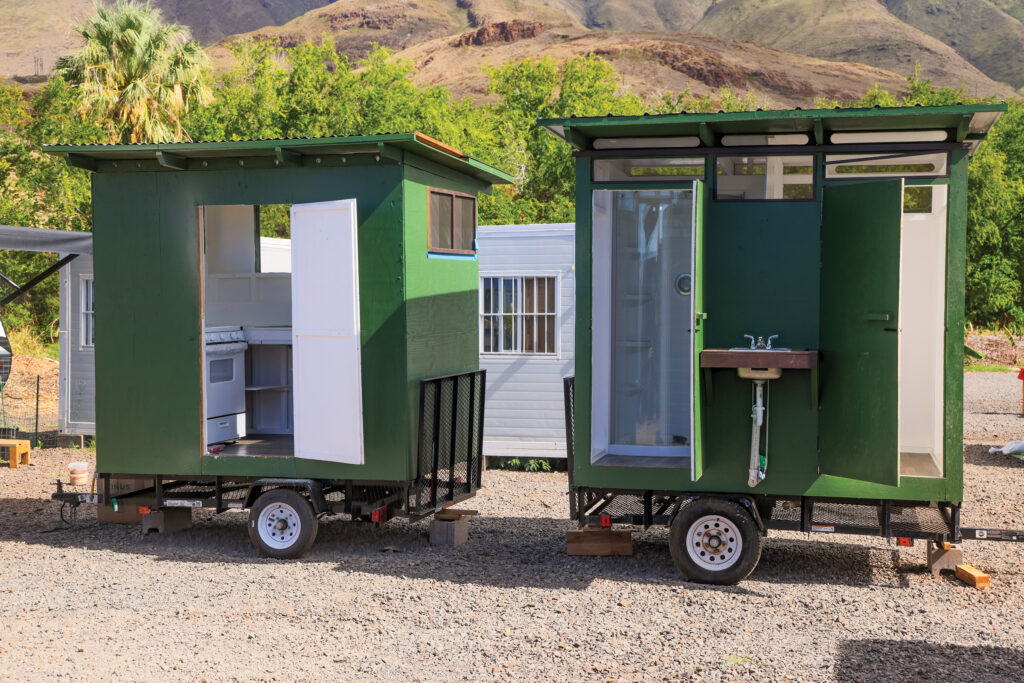
Temporary housing provided to residents while they rebuild
Garcia has been teaching folks in the community how to build tiny homesteads since well before the wildfires. But after Lahaina burned, Regenerative Education Centers received donations to feed people and build them small, temporary homes, which are intended for families to keep as a secondary housing unit on their property once they’re able to rebuild permanently on their own land.
With a list of nearly 500 people whose homes burned down, Garcia’s nonprofit is turning 100 shipping containers into houses for folks most in need, retrofitting each one with a solar energy system, bathroom, and kitchen — all completely self-sufficient. These homes can be set up on agricultural land until families are allowed to return to their properties. So far, 40 have been given away, with new families added to the list every week.
Garcia explains that right after the fires, this space became a storage base for rescue operations and supplies being delivered to the island by boat and air. “That went on for a few months, but then we quickly saw the redundancy of old food coming from a lot of these nonprofits. Diapers, old clothes, stuff that was just piling up everywhere, so we decided to switch gears. It was like, How can we utilize the nonprofit we have and help our community? For one, we can feed people good food, not the stuff coming from the food banks and outdated canned food. We can feed them living, fresh vegetables and greens that we already have growing in the back.”
He motions me to follow him further, and we wade through more water, up to some raised gardens and mounds of earth brimming with fruits and vegetables of all kinds. The amount of growth and produce flourishing in the plots is astounding.
He points down to a mutant-like vegetable growing on a vine and says, “Check this out.” It’s a squash the size of a football. “Within the first few months, we had tens of thousands of pounds of food growing in the ground. Since then, we’ve given well over 40,000 pounds of food away, and are actively giving away around 300 pounds a week to all people who are victims of the fire disaster and need fresh food.
“Not a single drop of fertilizer or pesticide,” Garcia adds, proudly. “Just consistency, hard work, and a community that wants to grow this way and show stewardship. Most of what is grown here is known as the voyaging plants. These are the plants that were originally carried here by canoe. People can also come here and get trees from us.”
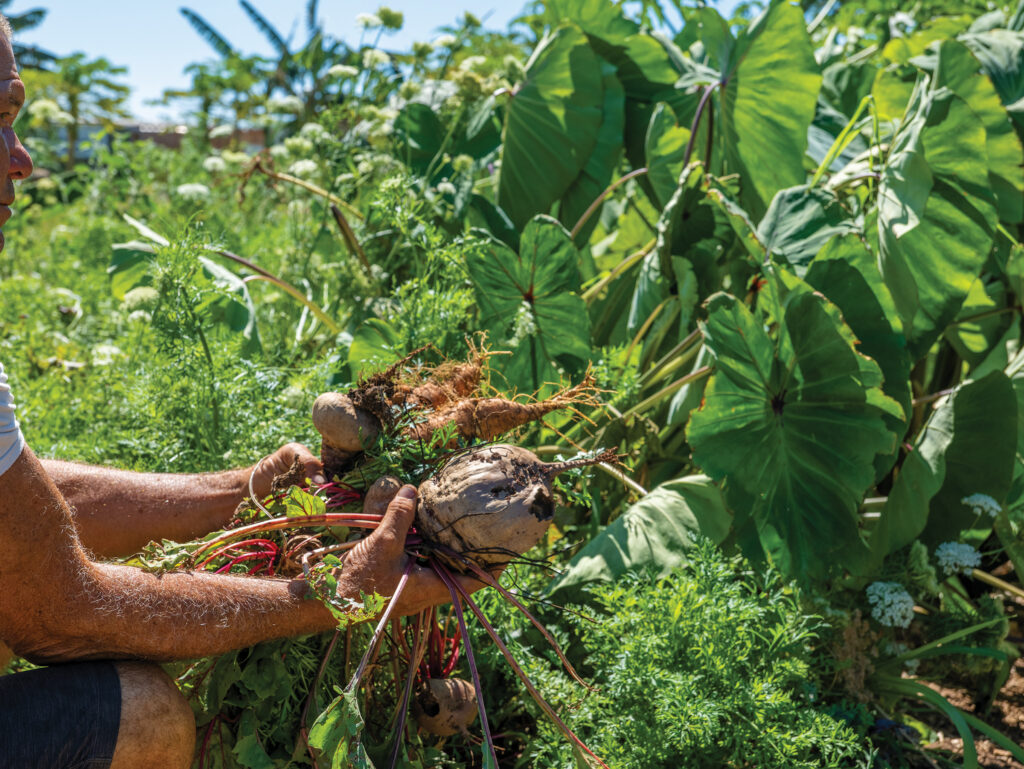
1. Beets and carrots are just some of the crops grown on the property.
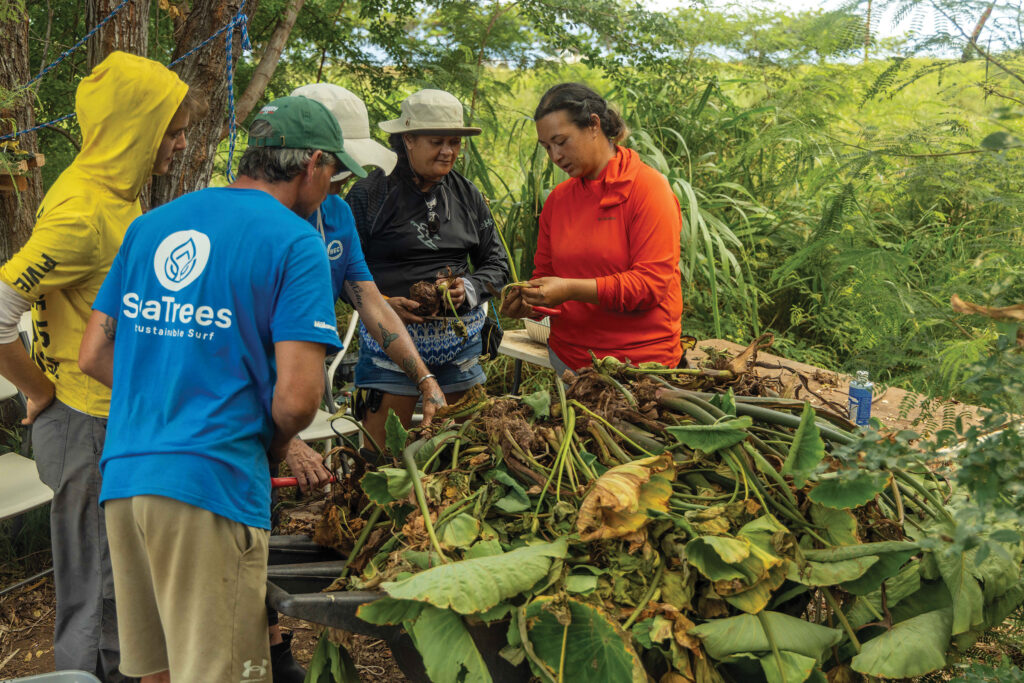
2. The crew sorts through a Taro harvest. Taro is a nutrient-dense root vegetable and a staple of Hawaiian cuisine.
Garcia explains that part of the reason Lahaina burned the way it did is that agricultural companies razed its wetlands — specifically, thousands of ‘ulu (breadfruit) trees — in the 1800s. “Beyond just being very bad agricultural management, clearing all the ‘ulu trees was culturally traumatic for the Native Hawaiians, too,” Garcia continues. “Trees were planted as family, to the extent that a newborn’s placenta was buried beneath the tree. So, cutting down that tree was like cutting down a part of your family.”
Regenerative Education Centers teamed up with a micro-propagation company to mass-produce ‘ulu from strains of the original breadfruit trees, which were stored in a genetic bank. This began a process of creating thousands of new ‘ulu trees in Lahaina after the fires. “Reforesting with some of these ancient strains of breadfruits, the goal is just trying to give something back to our community and bring some change that could be significant for generations to come,” Garcia says. “An ‘ulu tree, by the time they’re old, can produce thousands upon thousands of pounds of harvest. They’re literally some of the most prolific food trees on the planet.”
“We want to have agriculture that’s fed by culture, right?” Garcia asks. We certainly do.